
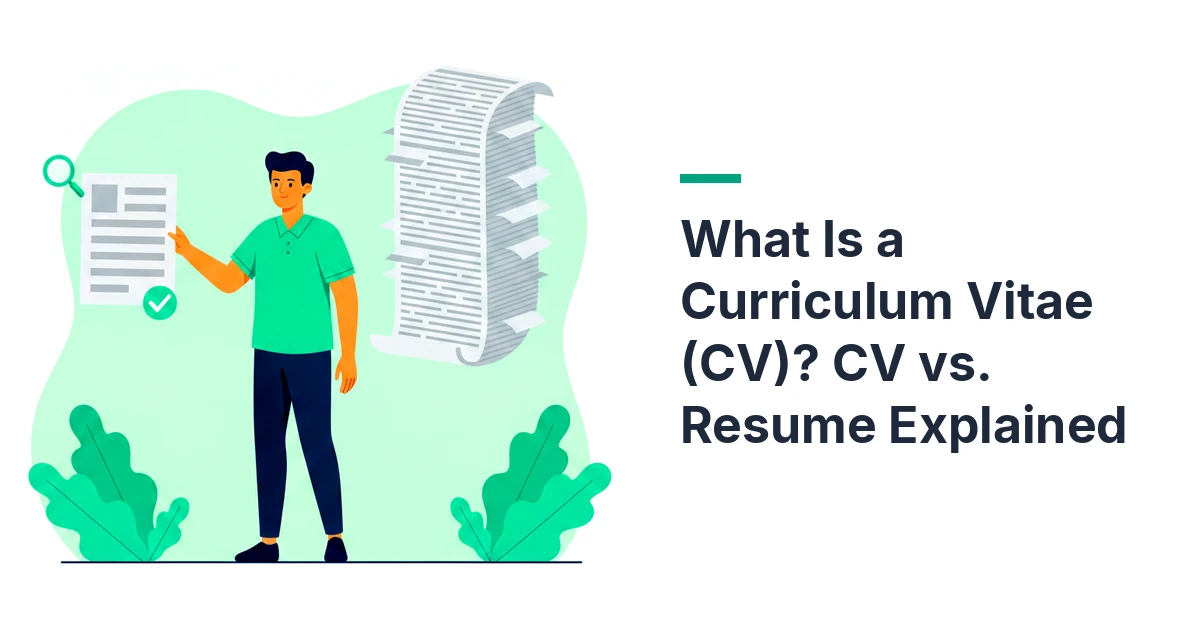
What Is a Curriculum Vitae (CV)? CV vs. Resume Explained
If you've ever stared at a job posting wondering whether to send a CV or a resume, and whether there's even a difference, you're not alone. Beginners and entry-level applicants ask this exact question every day. And picking the wrong document, or the wrong content inside it, can quietly sink an application before a human ever reads it.
Here's the short answer: a CV is a long, comprehensive record of your entire academic and professional life. A resume is a short, targeted snapshot built for one specific job. In the US they're two different documents used in two different situations. This guide breaks down what each one is and exactly when to use it, in plain language.
Key Takeaways
- A CV (curriculum vitae) is a detailed, multi-page record of your full academic and professional history. Use it for academia, research, grad school, and most international applications.
- A resume is a concise, one-to-two-page document tailored to a specific job. Use it for the vast majority of US private-sector roles.
- Length is the fastest tell: resumes stay short, CVs grow with your career and have no strict limit.
- Terminology varies by country: in the UK, EU, and much of the world, "CV" just means what Americans call a resume.
- Choosing the right document is only step one. A generic resume still gets ignored by applicant tracking systems. Tailoring it to each job posting is what actually moves the needle.
What Is a Curriculum Vitae (CV)?
"Curriculum vitae" is Latin for "course of life," and that tells you almost everything you need to know. A CV is a detailed, comprehensive record of your full academic and professional history. It leaves nothing out. Where a resume trims and selects, a CV documents.
So when someone asks what a CV format is supposed to include, the answer is: pretty much all of it. A typical CV covers:
- Education and academic degrees
- Publications and research
- Teaching and lecturing experience
- Conference presentations and talks
- Grants, awards, and honors
- Professional memberships and affiliations
Because it captures everything, a CV has no strict length limit. It grows as your career grows. Academic researchers juggle many projects at once, so it helps to think of a CV as a living document, as the UNC Writing Center puts it. You add to it over the years rather than rewriting it from scratch.
CVs are mainly used in academia, research, medicine, and scientific fields. There's a geographic wrinkle too: in Europe, the UK, and much of the rest of the world, "CV" is simply the standard word for the document Americans call a resume. More on that confusing overlap in a minute.
What Is a Resume? (Resume: What Is It?)
A resume is a strategic, targeted, concise overview of the most relevant skills, achievements, and experiences for a specific job. That definition comes straight from Princeton's career development office, and it's the clearest one out there. The key words are targeted and specific.
So what does a job resume look like in practice? It's the standard one-to-two-page document you use for most private-sector applications. It doesn't try to document your whole life. It picks the handful of things that matter for the role in front of you and puts them front and center.
The biggest mental shift for beginners is this: a resume is not an archive. It's a pitch. You rewrite and tailor it for each role rather than sending the same fixed file to every employer. A resume for a marketing job should read differently from a resume for a data analyst job, even if it's the same you behind both.
A resume answers one question: "Why should we interview you for this job?" A CV answers a different one: "Here is everything I have ever done." Confuse the two and you'll send the wrong signal every time.
CV vs. Resume: What's the Difference?
Is a CV the same as a resume? In the US, no. They differ in length, purpose, content focus, and where they're used. A CV is comprehensive and static. A resume is concise and tailored. Here's the direct comparison so you can see the difference at a glance.
| Factor | CV (Curriculum Vitae) | Resume |
|---|---|---|
| Length | 2+ pages, no set limit | 1 page (2 for experienced applicants) |
| Purpose | Document your full academic and professional history | Pitch your fit for one specific job |
| Content focus | Academic accomplishments, research, publications | Relevant skills and work experience |
| Approach | Comprehensive and static (a living archive) | Concise and tailored per role |
| Common uses | Academia, research, grad school, fellowships | Most private-sector and corporate jobs |
| Region | Standard in US academia; means "resume" in UK/EU | Standard term in the US and Canada |
Length and Format
A resume is typically one page, stretching to two only when you have years of relevant experience to show. A CV runs two or more pages, with no ceiling. A senior professor's CV can easily hit ten pages, and that's normal. If your document is short and selective, it's a resume. If it's long and complete, it's a CV.
Content Focus
A resume emphasizes relevant skills and work experience, cutting anything that doesn't support the target role. A CV emphasizes academic accomplishments, research, and publications, and keeps everything because completeness is the point. UC Davis sums it up well: a CV emphasizes involvement and academic accomplishments, while a resume emphasizes skills and experiences.
And that terminology gap? Worth repeating, because it trips people up constantly. In the US, CV and resume are different documents. In the UK, the EU, Australia, and most of the world, "CV" is just the everyday word for a resume. So if a British job listing asks for your CV, they want the short, tailored document, not a ten-page academic history.
When Do I Use a CV Instead of a Resume?
Use a CV when the role lives in the academic or research world. Use a resume for basically everything else in the US private sector. Here's the practical breakdown.
Send a CV for:
- Graduate school and PhD applications
- Academic faculty and teaching positions
- Research roles and lab positions
- Grants, fellowships, and scholarships
- Most international applications outside the US and Canada
Send a resume for:
- The vast majority of US corporate and private-sector jobs
- Anything in tech, marketing, finance, operations, sales, and similar fields
- Internships and entry-level roles at companies (not universities)
When you're not sure, use this checklist:
- Read the job posting's exact wording. If it says "resume," send a resume. If it says "CV" and the employer is US-based and non-academic, they usually still mean a resume.
- Check the industry. University, hospital, or research lab? Lean CV. Company? Lean resume.
- Check the country. Outside the US and Canada, "CV" almost always means a standard resume.
Match the regional convention and the posting's language, and you'll rarely get it wrong.
What Goes on a Resume?
Since most readers here need a resume, let's get specific about what belongs on one. A strong resume is built from a few essential sections, plus optional ones that help when your work history is thin.
Essential Resume Sections
- Contact information: name, phone, email, city, and a LinkedIn or portfolio link
- Professional summary: two or three lines framing who you are and what you bring
- Work experience: your roles, listed most recent first, focused on achievements
- Skills: the hard and soft skills that match the job
- Education: degrees, institutions, and graduation dates
Optional sections earn their place when they're relevant: certifications, projects, volunteer work, and coursework. Prioritize achievements with measurable results over lists of duties. "Managed social media" says nothing. "Grew Instagram following from 2,000 to 15,000 in six months" says everything. Numbers make a recruiter stop scanning and start reading.
What to leave off? Irrelevant old jobs, personal details like age or marital status, and references. You don't need to write "references available on request" either. Everyone knows they are.
Entry-Level Tips
If your work history is thin, flip the usual order. Lead with education, then highlight internships, relevant coursework, class projects, and transferable skills. A student who built a budgeting spreadsheet for a campus club has real, describable experience. Frame it that way. You have more to work with than you think.
Why the Right Document Isn't Enough: Tailoring to the Job Description
Choosing between a CV and a resume is step one. But here's the hard truth: a generic resume, even a well-formatted one, still gets ignored. Sending the same file to 50 companies and hearing nothing back is the single most common frustration for entry-level applicants. And it's usually not because you're unqualified.
It's because of the software in front of the recruiter.
Most mid-size and large employers run applications through an Applicant Tracking System (ATS) like Workday, Greenhouse, Lever, iCIMS, or Taleo. These systems screen resumes for relevance to the job description before a human ever opens them. If your resume doesn't reflect the language and priorities of the specific posting, it can get filtered out early.
Tailoring is the fix. It means aligning your skills, keywords, and achievements to each specific posting instead of sending one static document everywhere. The ats score most systems calculate breaks down into five weighted components:
- Keyword Match (40 points): the biggest factor, and the one tailoring affects most
- Skills Alignment (20 points)
- Experience Relevance (20 points)
- Overall Presentation (10 points)
- Qualifications Match (10 points)
Notice that keyword match and skills alignment together account for 60 of 100 points. Both are things you control by matching your resume keywords to the posting. This is exactly why resume tailoring moves the needle when a generic blast doesn't.
Doing this by hand for every application is slow and tedious, which is where AI tools come in. cvtailor.ai reads a job description and your resume, then shows you where they align and where they fall short, so you can tailor your resume to each role in minutes instead of hours. You can also run a free ats checker to see your current score before you apply.
Stop sending the same resume everywhere
Now that you know the difference between a CV and a resume, and when to use each, the next step is making your document actually stand out. Tailoring your resume to each job description is what moves you from ignored to interviewed.
Frequently Asked Questions
Is a CV the same as a resume?
In the US, no. A CV is a long, comprehensive record of your full academic and professional history, often two or more pages. A resume is a concise, one-to-two-page document tailored to a specific job. But in the UK, EU, and most of the world, "CV" is simply the standard word for what Americans call a resume, so context and country matter.
When do I use a CV instead of a resume?
Use a CV for graduate and PhD applications, academic faculty roles, research positions, grants and fellowships, and most international applications outside the US and Canada. Use a resume for the vast majority of US private-sector and corporate jobs. When in doubt, follow the exact wording in the job posting and match regional conventions.
What goes on a resume?
The core sections are contact information, a professional summary, work experience, skills, and education. Optional sections like certifications, projects, volunteer work, and relevant coursework help when your work history is thin. Leave off irrelevant jobs, personal details, and references. Focus on achievements with measurable results rather than lists of duties.
Can I use a CV for a regular job in the US?
Generally, no. For most US corporate and private-sector roles, employers expect a concise resume, not a multi-page academic CV. Sending a long CV to a company job can signal that you don't understand the norms of that field. Save the CV for academic, research, and medical or scientific positions.
How long should a resume be?
One page is the standard, especially for students, recent graduates, and early-career applicants. Two pages is acceptable once you have several years of relevant experience worth showing. If you're stretching to fill a second page with weak content, cut it back to one strong page instead.
Related Articles
Is 70 a Good ATS Score for Your Resume? What It Means
Is 70 a good ATS score for your resume? Learn what the number means, what a healthy score range looks like, and the 5 factors that move your ATS score up.
How Many Bullet Points Per Job on a Resume? (Rule + Examples)
How many bullet points per job on a resume? Use 3-6 bullets, scaled by seniority and recency. See before/after examples plus a printable rule of thumb.
Reverse-Chronological Format Resume: The ATS-Safe Guide
Learn why the reverse-chronological format resume is the safest structure for ATS parsing, when it wins, when a gap hurts it, and how to build one right.