
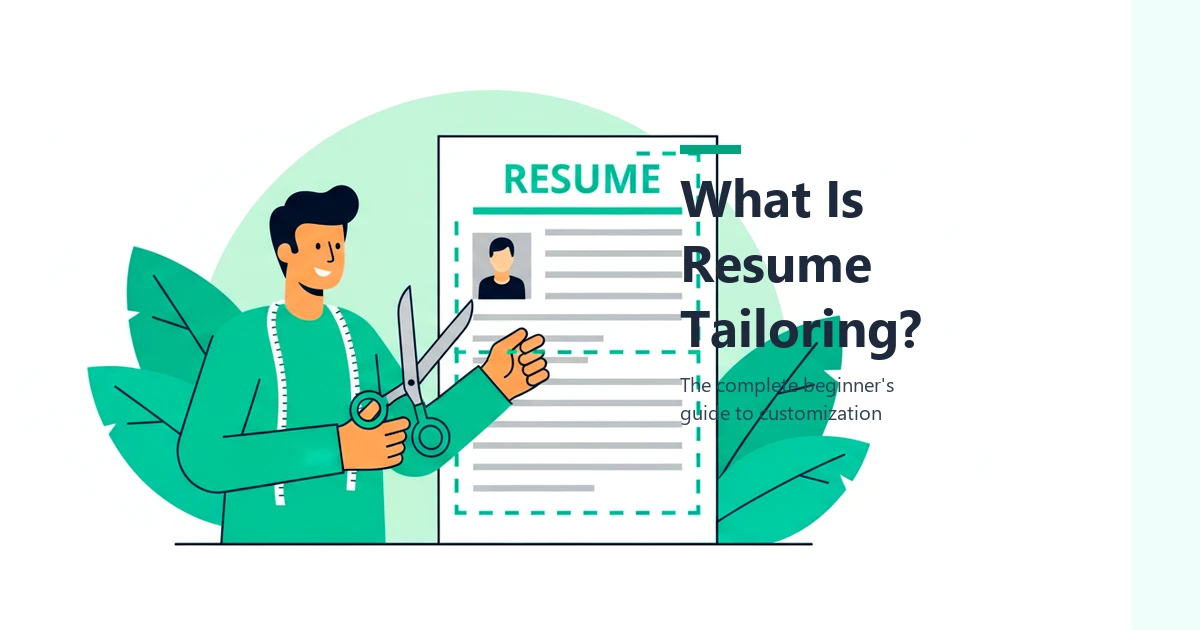
What is Resume Tailoring? The Complete Beginner's Guide
Hiring managers spend an average of 6 to 10 seconds scanning your resume. In that window, they need to see that your skills match their open role. A generic resume forces them to connect the dots. A tailored resume makes the connection obvious.
If you have been sending out the same resume to every job and wondering why you are not hearing back, resume tailoring is likely the missing piece. It is not complicated, it does not require starting from scratch, and once you understand the process, it takes minutes instead of hours.
Here is everything you need to know about resume tailoring: what it is, why it matters, and how to do it effectively.
Key Takeaways
- Resume tailoring means adjusting your existing resume to highlight the skills and experience most relevant to a specific job posting. It is not rewriting from scratch.
- Tailored resumes pass ATS screening at much higher rates. A generic resume typically scores around 55% on ATS, while a tailored resume can reach 85%+.
- Five areas to tailor: your professional summary, skills section, experience bullets, job title framing, and keyword language.
- Manual tailoring takes 30 to 60 minutes. Tools like cvtailor.ai reduce that to under 2 minutes by automatically matching your resume to the job description.
What Does Resume Tailoring Mean?
Resume tailoring is the process of customizing your existing resume to match a specific job posting. You take the same experience, skills, and qualifications and adjust how they are presented to align with what a particular employer is looking for.
Think of it like this: you have one wardrobe, but you wear different outfits depending on the occasion. A tailored resume is the right outfit for the right occasion. You are not inventing new experience or fabricating skills. You are spotlighting the parts of your background that matter most for this particular role.
In practice, tailoring means:
- Adjusting your professional summary to mention the exact job title and key skills from the posting
- Reordering your skills section to lead with what the employer prioritizes
- Tweaking your experience bullets to use the same language the job description uses
- Adding relevant skills you have but may have left off your default resume
What tailoring is not: creating an entirely new resume for every application. You should have one strong master resume that you adjust for each job. The core content stays the same. The emphasis shifts.
Why Resume Tailoring Matters
There are two gatekeepers between your resume and an interview: software and humans. Tailoring helps you pass both.
The software gatekeeper: ATS. Over 90% of mid-to-large companies use Applicant Tracking Systems to screen resumes. The ATS scores your resume by comparing it against the job description. A generic resume that is not tailored to the specific posting will almost never score above 60%, which means it gets filtered out before a recruiter ever sees it. 75% of resumes are rejected at this stage.
The human gatekeeper: the recruiter. Even after your resume passes ATS, a recruiter spends just 6 to 10 seconds deciding whether to read further. A tailored resume makes your fit for the role immediately obvious. A generic resume requires the recruiter to interpret your background and figure out whether you might be a match. Most will not bother when they have hundreds of other applications to review.
The bottom line: tailored resumes get 2 to 3 times more interview callbacks than generic ones. It is the single highest-impact thing you can do in your job search.
Tailored Resume vs. Generic Resume
Here is what the difference looks like in practice:
| Factor | Generic Resume | Tailored Resume |
|---|---|---|
| Approach | Same document sent to every job | Adjusted for each specific posting |
| Language | Broad, general terms | Mirrors the job description's exact phrasing |
| ATS Score | Typically 45-60% | Typically 80-90% |
| Recruiter impression | "Might be a fit, hard to tell" | "This person matches exactly what we need" |
| Interview callback rate | ~10-15% | ~35-45% |
| Time per application | 2 minutes | 30-60 min (manual) or 2 min (with tools) |
The difference is not about having better experience. It is about presenting the same experience in a way that clearly matches what the employer is asking for.
What to Tailor on Your Resume (5 Areas)
You do not need to rewrite your entire resume for every job. Focus on these five areas, and you will cover 90% of what matters for ATS scoring and recruiter impression.
1. Professional Summary
Your summary sits at the top of your resume and sets the frame for everything below it. For each application, swap in:
- The exact job title from the posting (e.g., "Senior Product Manager" not just "experienced manager")
- The top 3 to 5 keywords from the job description
- One achievement that is directly relevant to this specific role
This takes about 3 minutes per application and has an outsized impact on both ATS scoring and recruiter first impressions.
2. Skills Section
Your skills section is the keyword-densest part of your resume. For each application:
- Reorder your skills so the ones mentioned in the job description appear first
- Add any skills from the posting that you genuinely have but left off your default resume
- Remove skills that are not relevant to this role to reduce noise and keep the section focused
3. Experience Bullets
This is where most of the tailoring impact happens. You are not changing what you did. You are changing how you describe it to match the employer's language.
- If the job says "project management" and your bullet says "managed projects," change it to "project management"
- Emphasize the achievements most relevant to this role by moving them higher in each job entry
- Use the exact keywords from the posting within your achievement statements
4. Job Titles (When Appropriate)
Sometimes your official title does not clearly communicate what you actually did. When this happens, you can add a clarifying equivalent in parentheses.
For example: if your title was "Associate" but you functioned as a "Marketing Coordinator," you could write "Associate (Marketing Coordinator)" when applying for marketing roles. Only do this when the clarification is truthful and reflects your actual responsibilities.
5. Keywords and Phrasing
ATS systems look for exact keyword matches. "Data analysis" and "analyzed data" are not the same to a machine. Go through the job description and make sure your resume uses the same phrasing, not synonyms or paraphrases.
Always include both the acronym and the full term: "Search Engine Optimization (SEO)" covers you whether the ATS searches for one or the other. For a deeper dive on keyword strategy, see our complete resume keywords guide.
How to Tailor Your Resume: Step by Step
If you are new to tailoring, here is the simplest process to follow:
- Read the job description carefully. Highlight every skill, tool, certification, and qualification mentioned. Pay extra attention to terms that appear more than once.
- Compare your resume against those terms. Go through your highlighted list and check which keywords already appear on your resume and which are missing.
- Adjust your summary, skills, and experience bullets. Add missing keywords where truthful, reorder to match the JD's priorities, and mirror the posting's exact language.
- Check your ATS score. Upload your updated resume and the job description to an ATS checker to verify your match score is 80% or higher. Fix any remaining gaps.
For a more detailed walkthrough with examples, see our guide on how to tailor your resume to a job description.
How Long Does Resume Tailoring Take?
| Method | Time Per Application | Typical ATS Score |
|---|---|---|
| No tailoring (generic resume) | 2 minutes | 45-60% |
| Manual tailoring (first time) | 45-60 minutes | 80-90% |
| Manual tailoring (with practice) | 15-20 minutes | 80-90% |
| Automated with cvtailor.ai | Under 2 minutes | 80-90% |
The math is straightforward: if you are applying to 10 jobs per week and manual tailoring takes 30 minutes each, that is 5 hours per week on tailoring alone. Automating the process with a tool like cvtailor.ai gives you the same quality result in a fraction of the time, freeing up hours for networking, interview prep, and other high-impact activities.
Common Resume Tailoring Mistakes
Tailoring is simple in concept, but these common mistakes can undermine your efforts:
- Rewriting the entire resume from scratch. Tailoring is about adjusting emphasis, not starting over. Keep one master resume and modify it for each application.
- Only tailoring the cover letter. ATS scores your resume, not your cover letter. If you are only customizing the cover letter, you are missing the part that actually determines whether a recruiter sees your application.
- Adding keywords you cannot back up. If you claim "Python" as a skill but have never written Python code, you will be exposed in the interview. Only include keywords that reflect your genuine experience.
- Using a different format for every application. Keep your ATS-friendly format consistent. Change the content, not the structure.
- Not checking your score after tailoring. Without verifying your ATS match score, you are guessing. Use an ATS checker to confirm your tailored resume scores 80%+ before applying.
Tailor Your Resume Automatically with cvtailor.ai
Resume tailoring works. The challenge is doing it efficiently when you are applying to multiple jobs. That is exactly what cvtailor.ai was built for.
- Upload your resume and paste the job description you are targeting
- See your match score instantly with a clear breakdown of which keywords are missing
- Get a tailored resume in one click. The tool adjusts your summary, skills, and experience to match the job description's language and priorities
- Re-check your score to confirm you are above 80% before submitting
Instead of spending 30 to 60 minutes per application manually adjusting your resume, you get a professionally tailored, ATS-optimized version in seconds.
Tailor Your Resume in One Click
Upload your resume and paste any job description. cvtailor.ai matches your experience to the job's requirements, inserts the right keywords, and delivers a tailored resume instantly. Stop sending generic resumes that get filtered out.
Frequently Asked Questions
What does it mean to tailor a resume?
Tailoring a resume means customizing your existing resume to match a specific job posting. You adjust your professional summary, skills, and experience bullets to highlight the qualifications most relevant to that role, using the same language and keywords from the job description. It is not about creating a new resume from scratch, but about shifting emphasis to match what the employer is looking for.
Is it worth tailoring your resume?
Yes. Tailored resumes get 2 to 3 times more interview callbacks than generic ones. A generic resume typically scores 45-60% on ATS, while a tailored resume can score 80-90%. Since 75% of resumes are filtered out by ATS before a human reads them, tailoring is often the difference between getting an interview and getting ignored.
How much should I tailor my resume?
Focus on five areas: your professional summary (swap in the job title and top keywords), skills section (reorder to match the JD), experience bullets (mirror the posting's language), job title framing (clarify vague titles when truthful), and keyword phrasing (use exact terms, not synonyms). You do not need to rewrite the entire resume. These adjustments typically take 15 to 30 minutes manually, or under 2 minutes with an automated tool.
What is the difference between a tailored and general resume?
A general resume uses broad language and is sent to every job without changes. A tailored resume is customized for each application, mirroring the job description's keywords and emphasizing the most relevant experience. The practical impact: general resumes score around 55% on ATS (often auto-filtered), while tailored resumes score 80-90% and consistently reach human reviewers.
Does tailoring a resume work?
Yes. Tailoring directly addresses the two biggest reasons resumes get rejected: missing keywords (which causes ATS filtering) and unclear relevance (which causes recruiters to pass). By matching your resume's language to the job description, you improve both your ATS score and your first impression with the human reviewer. The result is measurably higher interview callback rates.
Related Articles
Resume Keywords Guide: How to Find and Use the Right Keywords to Get Hired
Learn how to find and use the right resume keywords to pass ATS and land interviews. Includes industry-specific keyword lists for Tech, Marketing, Finance, Healthcare, Sales, and Operations.
How to Optimize Your Resume for ATS: The Complete 2025 Guide
Learn how to optimize your resume for ATS with this complete guide. Covers formatting rules, keyword strategy, file types, fonts, section headers, and tools to boost your ATS score.
How to Pass ATS Screening: 11 Proven Steps to Beat Applicant Tracking Systems
Learn how to pass ATS screening with 11 proven steps. Discover what ATS looks for, why 75% of resumes get rejected, and how to beat applicant tracking systems.